
Cargo drones vs trucks in the mid-mile: An integrated cost, reliability, and emissions analysis for sustainable logistics

Article Sidebar
-
cargo drones, mid-mile logistics, UAV transportation, emissions modelling, reliability analysis, sustainable freight systems
Abstract
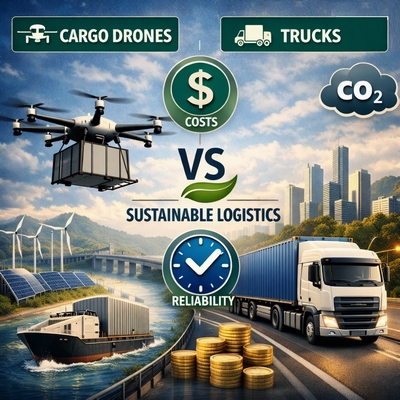
Purpose. This paper investigates whether cargo drones can serve as a viable, sustainable alternative to diesel trucks in mid-mile freight logistics, an operational segment linking regional hubs and fulfilment points that remains dependent on fossil-fuel trucking despite mounting cost, emissions, and regulatory pressures. Methodology. An integrated, scenario-based analytical framework compares drones and trucks across cost, carbon emissions, and operational reliability. The framework combines modular cost decompositions, first-principles emissions accounting, and a simplified additive reliability model, parameterised with consolidated secondary data on energy prices, grid carbon intensity, and weather-driven unmanned aerial vehicle performance across five representative operational scenarios. Results. Drones deliver lower per-kilometre operating costs than trucks in most high-demand and high-fuel-price scenarios and consistently achieve 80-90 percent lower emissions across all scenarios. Reliability is the binding constraint: drone availability drops sharply under adverse weather, while trucks maintain stable performance across nearly all conditions. Theoretical contribution. The study extends the drone-logistics literature, previously concentrated on last-mile, single-dimension assessments, by offering one of the first integrated, multi-criteria comparative frameworks for mid-mile operations and by showing that climatic and grid-decarbonisation factors, not technology maturity alone, determine modal competitiveness. Practical implications. The findings support hybrid truck-drone network design, weather-adaptive routing, and prioritised regulatory pathways for Beyond Visual Line of Sight corridors in climatically stable, decarbonising regions, providing operators and policymakers with a decision-support basis for sustainable freight modal choice.
SDG 9: Industry, Innovation and Infrastructure; SDG 11: Sustainable Cities and Communities; SDG 12: Responsible Consumption and Production; SDG 13: Climate Action
Full text article
References
Bao, D., Yan, Y., Li, Y., & Chu, J. (2025). The Future of Last-Mile Delivery: Lifecycle Environmental and Economic Impacts of Drone-Truck Parallel Systems. Drones, 9(1), 54. https://doi.org/10.3390/drones9010054
Betti Sorbelli, F. (2024). UAV-based delivery systems: A systematic review, current trends, and research challenges. Journal on Autonomous Transportation Systems, 1(3), 1-40. https://doi.org/10.1145/3649224
Bridgelall, R. (2024). Spatial Analysis of Middle-Mile Transport for Advanced Air Mobility: A Case Study of Rural North Dakota. Sustainability, 16(20), 25, Article 8949. https://doi.org/10.3390/su16208949
Bruzzone, F., Nocera, S., & Pesenti, R. (2023). Feasibility and optimization of freight-on-transit schemes for the sustainable operation of passengers and logistics. Research in Transportation Economics, 101, 10, Article 101336. https://doi.org/10.1016/j.retrec.2023.101336
Chiang, W.-C., Li, Y., Shang, J., & Urban, T. L. (2019). Impact of drone delivery on sustainability and cost: Realizing the UAV potential through vehicle routing optimization. Applied Energy, 242, 1164-1175. https://doi.org/https://doi.org/10.1016/j.apenergy.2019.03.117
Danchuk, V., Comi, A., Weiß, C., & Svatko, V. (2023). The optimization of cargo delivery processes with dynamic route updates in smart logistics. Eastern-European Journal of Enterprise Technologies, 2(3 (122)), 64-73. https://doi.org/10.15587/1729-4061.2023.277583
Dorling, K., Heinrichs, J., Messier, G. G., & Magierowski, S. (2017). Vehicle Routing Problems for Drone Delivery. 47(1), 70-85. https://research.ebsco.com/linkprocessor/plink?id=93af2f51-8727-33a9-8336-ea0df33edfd6
EC. (2023). Further development and update of VECTO with new technologies (Specific contract No 340201/2020/835254/SER/CLIMA.C.4, Issue. https://climate.ec.europa.eu/document/download/e18121d1-4c73-4292-a5d1-d3e1584ba195_en?filename=policy_transport_vecto_fd2_en.pdf
EPA. (2025). Mobile Source Emission Factors Research. United States Environmental Protection Agency Retrieved 1 December 2025 from https://www.epa.gov/moves/mobile-source-emission-factors-research
Eskandaripour, H., & Boldsaikhan, E. (2023). Last-Mile Drone Delivery: Past, Present, and Future [Review]. Drones, 7(2), 19, Article 77. https://doi.org/10.3390/drones7020077
European Council. (2023). Fit for 55: Towards more Sustainable Transport. https://www.consilium.europa.eu/en/infographics/fit-for-55-afir-alternative-fuels-infrastructure-regulation/
Figliozzi, M. (2024). Analyzing the Impact of Technological Improvements on the Performance of Delivery Drones. Transportation Research Procedia, 79, 68-75. https://doi.org/https://doi.org/10.1016/j.trpro.2024.03.011
Figliozzi, M. A. (2020). Carbon emissions reductions in last mile and grocery deliveries utilizing air and ground autonomous vehicles. Transportation Research Part D, 85. https://doi.org/10.1016/j.trd.2020.102443
Figliozzi, M., & Hadas, Y. (2024). Drone-Truck Fleet Allocation Policies for Courier Deliveries: Evaluating of Distance and Energy Trade-Offs. Decision Science Alliance International Summer Conference. https://doi.org/10.1007/978-3-031-78241-1_25
Figliozzi, M., & Jennings, D. (2020). Autonomous delivery robots and their potential impacts on urban freight energy consumption and emissions. Transportation Research Procedia, 46, 21-28. https://doi.org/https://doi.org/10.1016/j.trpro.2020.03.159
Figliozzi, M., Saenz, J., & Faulin, J. (2020). Minimization of urban freight distribution lifecycle CO2e emissions: Results from an optimization model and a real-world case study. Transport Policy, 86, 60-68. https://doi.org/10.1016/j.tranpol.2018.06.010
Gao, M., Hugenholtz, C. H., Fox, T. A., Kucharczyk, M., Barchyn, T. E., & Nesbit, P. R. (2021). Weather constraints on global drone flyability. Scientific Reports, 11(1). https://doi.org/10.1038/s41598-021-91325-w
García, A., Monsalve-Serrano, J., Martinez-Boggio, S., Gaillard, P., Poussin, O., & Amer, A. A. (2020). Dual fuel combustion and hybrid electric powertrains as potential solution to achieve 2025 emissions targets in medium duty trucks sector. Energy conversion and management, 224, 113320. https://doi.org/10.1016/j.enconman.2020.113320
García, A., Monsalve-Serrano, J., Sari, R. L., & Gaillard, P. (2020). Assessment of a complete truck operating under dual-mode dual-fuel combustion in real life applications: Performance and emissions analysis. Applied Energy, 279, 115729. https://doi.org/10.1016/j.apenergy.2020.115729
Glick, T. B., Figliozzi, M. A., & Unnikrishnan, A. (2022). Case study of drone delivery reliability for time-sensitive medical supplies with stochastic demand and meteorological conditions. Transportation Research Record, 2676(1), 242-255. https://doi.org/10.1177/03611981211036685
Gunady, N., Vashi, S., Kim, B., Chao, H., DeLaurentis, D. A., & Crossley, W. A. (2023). Exploring middle mile cargo operations with urban air mobility across metro areas. In AIAA AVIATION 2023 Forum (p. 4471). https://doi.org/10.2514/6.2023-4471
Huang, X., Song, K., Huang, L., Feng, Y., & Wang, Z. (2024). Performance analysis of fuel cells for high altitude long flight multi-rotor drones (0148-7191). https://doi.org/10.4271/2024-01-2177
ICAO. (2023). Unmanned Aircraft Systems Traffic Management (UTM) – A Common Framework with Core Principles for Global Harmonization. https://www.icao.int/sites/default/files/left-menu-pdfs/UTM%20Framework%20Edition%204.pdf
IEA. (2025). CO2 emissions from fuel combustion. International Energy Agency. Retrieved 2nd December from https://www.iea.org/analysis?type=report
Jahani, H., Khosravi, Y., Kargar, B., Ong, K.-L., & Arisian, S. (2025). Exploring the role of drones and UAVs in logistics and supply chain management: a novel text-based literature review. International Journal of Production Research, 63(5), 1873-1897. https://doi.org/10.1080/00207543.2024.2373425
Kim, S. J., Lim, G. J., & Cho, J. (2018). Drone flight scheduling under uncertainty on battery duration and air temperature. Computers & Industrial Engineering, 117, 291-302. https://doi.org/10.1016/j.cie.2018.02.005
Kirschstein, T. (2020). Comparison of energy demands of drone-based and ground-based parcel delivery services. Transportation Research Part D: Transport and Environment, 78, 102209. https://doi.org/https://doi.org/10.1016/j.trd.2019.102209
Kumar, A., Prybutok, V., & Sangana, V. K. R. (2025). Environmental Implications of Drone-Based Delivery Systems: A Structured Literature Review. Clean Technologies, 7(1), 24. https://doi.org/10.3390/cleantechnol7010024
Lemardelé, C., Pinheiro Melo, S., Cerdas, F., Herrmann, C., & Estrada, M. (2023). Lifecycle analysis of last-mile parcel delivery using autonomous delivery robots. Transportation Research Part D: Transport and Environment, 121, 103842. https://doi.org/https://doi.org/10.1016/j.trd.2023.103842
Macioszek, E. (2018). First and Last Mile Delivery – Problems and Issues. In: Sierpiński, G. (eds) Advanced Solutions of Transport Systems for Growing Mobility. TSTP 2017. Advances in Intelligent Systems and Computing, vol 631. Springer, Cham. https://doi.org/10.1007/978-3-319-62316-0_12
Ovaere, M., & Proost, S. (2022). Cost-effective reduction of fossil energy use in the European transport sector: An assessment of the Fit for 55 Package. Energy Policy, 168, 113085. https://doi.org/https://doi.org/10.1016/j.enpol.2022.113085
Plötz, P., Wachsmuth, J., Sprei, F., Gnann, T., Speth, D., Neuner, F., & Link, S. (2023). Greenhouse gas emission budgets and policies for zero-Carbon road transport in Europe. Climate Policy, 23(3), 343-354. https://doi.org/10.1080/14693062.2023.2185585
Porzio, J., & Scown, C. D. (2021). Lifecycle assessment considerations for batteries and battery materials. Advanced Energy Materials, 11(33), 2100771. https://doi.org/10.1002/aenm.202100771
Purtell, C. T., Manuj, I., Pohlen, T. L., Garg, V., Porchia, J., & Hill, M. J. (2025). Innovators and transformers: envisioning a revolution in middle mile logistics with extended range cargo drones. International Journal of Physical Distribution & Logistics Management, 55(4), 376-393. https://doi.org/10.1108/ijpdlm-12-2023-0468
Quiros, D. C., Smith, J., Thiruvengadam, A., Huai, T., & Hu, S. (2017). Greenhouse gas emissions from heavy-duty natural gas, hybrid, and conventional diesel on-road trucks during freight transport. Atmospheric Environment, 168, 36-45. https://doi.org/10.1016/j.atmosenv.2017.08.066
Ragon, P.-L., & Rodríguez, F. (2022). Road freight decarbonization in Europe. https://theicct.org/wp-content/uploads/2022/09/road-freight-decarbonization-europe-sep22.pdf
Rai, S., Rawat, A., & Kumar, A. (2025). Design and performance analysis of high-altitude UAVs: trends, challenges, and innovations. Discover Applied Sciences, 7(8), 833. https://doi.org/10.1007/s42452-025-07357-8
Rejeb, A., Rejeb, K., Simske, S. J., & Treiblmaier, H. (2023). Drones for supply chain management and logistics: a review and research agenda. International Journal of Logistics Research and Applications, 26(6), 708-731. https://doi.org/10.1080/13675567.2021.1981273
Rojas Viloria, D., Solano-Charris, E. L., Muñoz-Villamizar, A., & Montoya-Torres, J. R. (2021). Unmanned aerial vehicles/drones in vehicle routing problems: a literature review. International Transactions in Operational Research, 28(4), 1626-1657. https://doi.org/https://doi.org/10.1111/itor.12783
Sigari, C., & Biberthaler, P. (2021). Medical drones: Disruptive technology makes the future happen. Der Unfallchirurg, 124(12), 974-976. https://doi.org/10.1007/s00113-021-01095-3
Stolaroff, J. K., Samaras, C., O’Neill, E. R., Lubers, A., Mitchell, A. S., & Ceperley, D. (2018). Energy use and life cycle greenhouse gas emissions of drones for commercial package delivery. Nature Communications, 9(1), 409. https://doi.org/10.1038/s41467-017-02411-5
Thibbotuwawa, A., Nielsen, P., Zbigniew, B., & Bocewicz, G. (2018). Energy consumption in unmanned aerial vehicles: A review of energy consumption models and their relation to the UAV routing. International Conference on Information Systems Architecture and Technology. https://doi.org/10.1007/978-3-319-99996-8_16
Thomas, T., Srinivas, S., & Rajendran, C. (2024). Collaborative truck multi-drone delivery system considering drone scheduling and en route operations. Annals of Operations Research, 339(1-2), 693-739. https://doi.org/10.1007/s10479-023-05418-y
Townsend, A., Jiya, I. N., Martinson, C., Bessarabov, D., & Gouws, R. (2020). A comprehensive review of energy sources for unmanned aerial vehicles, their shortfalls and opportunities for improvements. Heliyon, 6(11). https://doi.org/10.1016/j.heliyon.2020.e05285
Umlauf, R., & Burchardt, M. (2022). Infrastructure-as-a-service: Empty skies, bad roads, and the rise of cargo drones. Environment and Planning a-Economy and Space, 54(8), 1489-1509. https://doi.org/10.1177/0308518x221118915
Vedrtnam, A., Negi, H., & Kalauni, K. (2025). Materials and energy-centric life cycle assessment for drones: A review. Journal of Composites Science, 9(4), 169. https://doi.org/10.3390/jcs9040169
Wang, Z., Zheng, F., Sui, Y., Pan, H., Zhang, H., & Liu, M. (2025). Drone-truck collaborative scheduling with simultaneous delivery and pickup under uncertainty. Transportation Letters, 1-19. https://doi.org/10.1080/19427867.2025.2543379
Yowtak, K., Imiola, J., Andrews, M., Cardillo, K., & Skerlos, S. (2020). Comparative life cycle assessment of unmanned aerial vehicles, internal combustion engine vehicles and battery electric vehicles for grocery delivery. Procedia CIRP, 90, 244-250. https://doi.org/https://doi.org/10.1016/j.procir.2020.02.003
Zhao, Y., Noori, M., & Tatari, O. (2016). Vehicle to Grid regulation services of electric delivery trucks: Economic and environmental benefit analysis. Applied Energy, 170, 161-175. https://doi.org/10.1016/j.apenergy.2016.02.097
Zou, B., Kawamura, K., Sriraj, P. S., Qiu, Z., Lauster, E., & Jin, M. (2024). Understanding and Modeling Middle-Mile Logistics Automation (No. FERSC-2023-Project6-1).
Authors
Copyright (c) 2026 Luo Lihong, Zhou Mingyang, Lu Yonghua

This work is licensed under a Creative Commons Attribution 4.0 International License.
Authors retain copyright and grant the journal right of first publication, with the work simultaneously licensed under a CC BY 4.0 License that allows others to share the work with an acknowledgement of the work's authorship and initial publication in this journal.