
Supply chain bottlenecks and farmer profitability: A dynamic capabilities and value chain analysis of Zimbabwean horticulture

Article Sidebar
-
horticulture, supply chain management, Farmer Profitability, dynamic capabilities theory, Value Chain Analysis, postharvest losses, Climate-Smart Agriculture
Abstract
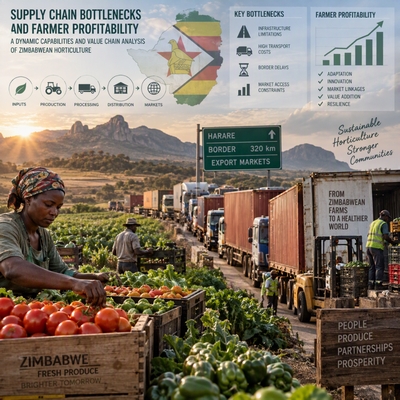
Purpose. Horticultural farmers in Mashonaland East Province, Zimbabwe, operate within a supply chain widely acknowledged as inefficient, yet prior research has treated individual bottlenecks such as transport, storage, or market access as isolated problems. This study addresses that gap by providing a holistic, context-specific analysis of how interrelated supply chain failures jointly undermine farmer profitability. Methodology. A qualitative multiple-case study design was adopted, in which 20 purposively selected farmers, each treated as an individual case, were interviewed using semi-structured protocols. Primary data were triangulated with a systematic review of 34 policy and grey literature documents. Interview transcripts were thematically analysed in NVivo 12 following Braun and Clarke's six-phase method, guided jointly by Dynamic Capabilities Theory (DCT) and Value Chain Analysis (VCA). Results. The analysis identifies six interlocking constraints: unreliable transportation networks, near-total absence of cold storage, high and volatile operational costs, severe market information asymmetry, intensifying climate change impacts, and limited adoption of modern farming technology, that reinforce one another rather than operating independently. Together they form a self-perpetuating cycle that erodes profit margins and steadily depletes farmers' capacity to adapt. Theoretical contribution. The study shows that combining dynamic capabilities theory with value chain analysis yields more explanatory power than either framework alone: VCA identifies precisely where value is lost along the chain, while DCT clarifies why farmers lack the sensing, seizing, and reconfiguring capacity to respond, revealing how meso-level systemic failures constrain micro-level adaptability and profitability. Practical implications. For policymakers, the findings support coordinated investment in rural infrastructure, decentralised cold storage, and digital market platforms rather than single-sector interventions. For practitioners and extension services, they point to the need for climate-smart training and market-literacy programs delivered together, not separately. For rural communities, addressing these constraints has direct implications for household income stability, reduced postharvest waste, and food security. The study also offers development agencies a diagnostic framework for identifying which combinations of constraints most urgently require simultaneous, rather than sequential, intervention.
Sustainable Development Goals (SDGs): SDG 1: No poverty; SDG 2: Zero hunger; SDG 8: Decent work and economic growth; SDG 9: Industry, innovation and infrastructure; SDG 12: Responsible consumption and production; SDG 13: Climate action
Full text article
References
Aryal, J. P., Sapkota, T. B., Khurana, R., & Khatri-Chhetri, A. (2020). Climate change and agriculture in South Asia: Adaptation options in smallholder production systems. Environment, Development and Sustainability, 22(6), 5045–5075. https://doi.org/10.1007/s10668-019-00414-4
Atinaf, M., Molla, A., & Anteneh, S. (2021). Towards a resilient information system for agriculture extension information service: An exploratory study. [arXiv preprint]. https://arxiv.org/abs/2108.09748
Ayim, C., Kassahun, A., Addison, C., & Tekinerdogan, B. (2022). Adoption of ICT innovations in the agriculture sector in Africa: A review of the literature. Agriculture & Food Security, 11, Article 22. https://doi.org/10.1186/s40066-022-00364-7
Balana, B., Mekonnen, D., Haile, B., Hagos, F., Yimam, S., & Ringler, C. (2020). Are smallholder farmers credit constrained? Evidence on demand and supply constraints of credit in Ethiopia and Tanzania. IFPRI Discussion Paper 1974. International Food Policy Research Institute. https://doi.org/10.2499/p15738coll2.134152
Baudron, F., & Giller, K. E. (2022). Agriculture and nature: Conflict or coexistence? Trends in Ecology & Evolution, 37(4), 301–312. https://doi.org/10.1016/j.tree.2021.11.006
Bellemare, M. F., & Novak, L. (2017). Contract farming and food security. American Journal of Agricultural Economics, 99(2), 357-378. https://doi.org/10.1093/ajae/aaw053
Bellemare, M. F., & Novak, L. (2022). Contract farming and food security. American Journal of Agricultural Economics, 104(4), 1225–1248. https://doi.org/10.1111/ajae.12285
Braun, V., & Clarke, V. (2006). Using thematic analysis in psychology. Qualitative Research in Psychology, 3(2), 77–101. https://doi.org/10.1191/1478088706qp063oa
Burgess, P. R., Sunmola, F. T., & Wertheim-Heck, S. (2023). A review of supply chain quality management practices in sustainable food networks. Heliyon, 9(11), Article e21179. https://doi.org/10.1016/j.heliyon.2023.e21179
Choruma, D. J., Dirwai, T. L., Mutenje, M. J., Mustafa, M., Chimonyo, V. G. P., Jacobs-Mata, I., & Mabhaudhi, T. (2024). Digitalisation in agriculture: a scoping review of technologies in practice, challenges, and opportunities for smallholder farmers in Sub-Saharan Africa. Journal of Agriculture and Food Research, 18, 101286. https://doi.org/10.1016/j.jafr.2024.101286
Coulter, J., & Onumah, G. (2002). The role of warehouse receipt systems in enhanced commodity marketing and rural livelihoods in Africa. Food Policy, 27(4), 319–337. https://doi.org/10.1016/S0306-9192(02)00018-0
Dube, L., & Guveya, E. (2020). Determinants of smallholder irrigation scheme performance in Zimbabwe. Water Policy, 22(5), 891–907. https://doi.org/10.2166/wp.2020.212
Food and Agriculture Organization. (2022). What factors shape small-scale farmers and firms’ adoption of new technologies? In FAO Investment Centre – Technology & Innovation for Sustainable Agriculture. https://www.fao.org/investment-centre/latest/news/detail/what-factors-shape-small-scale-farmers--and-firms--adoption-of-new-technologies/en/
Gumbi, N., Gumbi, L., & Twinomurinzi, H. (2023). Towards sustainable digital agriculture for smallholder farmers: A systematic literature review. Sustainability, 15(16), Article 12530. https://doi.org/10.3390/su151612530
Hussein, K., & Suttie, D. (2022). Rural infrastructure and agricultural development: A synthesis of IFAD’s experience. IFAD Research Series, 78. https://www.ifad.org/en/web/knowledge/-/publication/rural-infrastructure-and-agricultural-development-a-synthesis-of-ifad-s-experience
Jambo, I. J., & Mwambi, M. M. (2021). Postharvest losses and food security in Ethiopia: A meta-analysis. Food and Energy Security, 10(4), e315. https://doi.org/10.1002/fes3.315
Khonje, M. G., & Manda, J. (2022). Adoption and welfare impacts of agricultural technologies in Sub-Saharan Africa: A systematic review. Journal of Agricultural Economics, 73(2), 451–471. https://doi.org/10.1111/1477-9552.12468
Kilelu, C. W., Musyoka, D. M., & Kalele, D. N. (2024). Unraveling smallholder food loss and value for sustainable cold chain investments: A case of horticultural value chains in Kiambu County, Kenya. Agriculture, Food and Nutrition Security (AFNS) Program, African Centre for Technology Studies, Nairobi, Kenya. https://doi.org/10.3389/fhort.2024.1474056
Masere, T. P., & Worth, S. (2021). Influence of public agricultural extension on technology adoption by small-scale farmers in Zimbabwe. South African Journal of Agricultural Extension, 49(2). https://doi.org/10.17159/2413-3221/2021/v49n2a12785
Mhona, R., Muzari, W. M., & Soropa, G. (2025). Impact of institutional support to smallholder horticultural farmers on their access to high-value markets in Mashonaland West Province of Zimbabwe. Journal of Science, Innovation and Creativity, 4(2), 145–156. https://doi.org/10.58721/jsic.v4i2.1493
Miine, L. K., Akorsu, A. D., Boampong, O., & Bukari, S. (2023). Drivers and intensity of adoption of digital agricultural services by smallholder farmers in Ghana. Heliyon, 9(12), e23023. https://doi.org/10.1016/j.heliyon.2023.e23023
Mmbando, F. E., Wale, E., Baiyegunhi, L. J. S., & Darroch, M. A. G. (2016). The choice of marketing channel by maise and pigeonpea smallholder farmers: Evidence from the Northern and Eastern zones of Tanzania. Agrekon: Agricultural Economics Research, Policy and Practice in Southern Africa, 55(3), 254–277. https://doi.org/10.1080/03031853.2016.1203803
Mugambiwa, S. S. (2025). The impact of climate change on agricultural risks in Southern Africa: A case study of Mutoko District, Zimbabwe. Research on World Agricultural Economy, 6(2), 111–122. https://doi.org/10.36956/rwae.v6i2.1232
Muhoyi, E., & Mbonigaba, J. (2022). Stakeholder consultations on small-scale irrigation schemes' constraints in Zimbabwe. Environment, Development and Sustainability, 24, 13198–13217. https://doi.org/10.1007/s10668-021-01987-9
Muzondo, P. J., & Pashapa, R. (2025). Systematic literature review of sustainable supply chain management practices in developing countries: A focus on Zimbabwe. International Journal of Research and Innovation in Social Science, 9(5), 108. https://doi.org/10.47772/IJRISS.2025.90500012
Muzondo, P. J., Mashapure, R., & Masiiwa, S. T. (2025). Barriers and enablers in adopting circular business models in horticulture SMEs: Insights from Zimbabwe. Journal of Circular Economy, 3(3). https://doi.org/10.55845/GYQR3716
Ntwari, N., Yocgo, R., Ndokoye, P., & Kagabo, D. (2024). Mapping and forecasting of fall armyworm pest distribution in East Africa using climate information. Sustainability and Biodiversity Conservation, 3(1), 90–107. https://doi.org/10.5281/zenodo.11293684
Nyakudya, S., Jambo, N., Madududu, P., & Manyise, T. (2024). Unlocking the potential: challenges and factors influencing the use of ICTs by smallholder maise farmers in Zimbabwe. Cogent Economics & Finance, 12(1), 2330431. https://doi.org/10.1080/23322039.2024.2330431
Olabanji, M. F., & Chitakira, M. (2025). The adoption and scaling of climate-smart agriculture innovation by smallholder farmers in South Africa: A review of institutional mechanisms, policy frameworks and market dynamics. World, 6(2), Article 51. https://doi.org/10.3390/world6020051
Olwande, J., & Mathenge, M. (2020). Market access and smallholder agriculture: Evidence from Kenya. Agricultural Economics, 51(5), 677–692. https://doi.org/10.1111/agec.12586
Porter, M. E. (1985). Competitive advantage: Creating and sustaining superior performance. Free Press.
Saunders, B., Sim, J., Kingstone, T., Baker, S., Waterfield, J., Bartlam, B., Burroughs, H., & Jinks, C. (2018). Saturation in qualitative research: Exploring its conceptualisation and operationalisation. Quality & Quantity, 52(4), 1893–1907. https://doi.org/10.1007/s11135-017-0574-8
Shi, H., Zhang, Q., & Qin, J. (2024). Cold chain logistics and joint distribution: A review of fresh logistics modes. Systems, 12(7), 264. https://doi.org/10.3390/systems12070264
Tadesse, G., & Bahiigwa, G. (2015). Mobile phones and farmers’ marketing decisions in Ethiopia. World Development, 68, 296–307. https://doi.org/10.1016/j.worlddev.2014.12.010
Tamene, S. (2020). Rural road transport and its effects on smallholder farmers’ agricultural productivity and marketing: the case of Horro Guduru Wollega Zone, Western Ethiopia (Unpublished master’s thesis). Addis Ababa University. http://etd.aau.edu.et/handle/12345678/22459
Teece, D. J., Pisano, G., & Shuen, A. (1997). Dynamic capabilities and strategic management. Strategic Management Journal, 18(7), 509–533. https://doi.org/10.1002/(SICI)1097-0266(199708)18:7<509::AID-SMJ882>3.0.CO;2-Z
Waweru, O. W., & Olweny, T. (2023). Factors influencing commercialisation of smallholder farming in Kenya. The Strategic Journal of Business & Change Management, 10(2), 1227–1248. https://doi.org/10.61426/sjbcm.v10i2.2660
Wudad, A., Naser, S., & Lameso, L. (2021). The impact of improved road networks on marketing of vegetables and households' income in Dedo district, Oromia regional state, Ethiopia. Heliyon, 7(10), e08173. https://doi.org/10.1016/j.heliyon.2021.e08173
Yin, R. K. (2018). Case study research and applications: Design and methods (6th ed.). SAGE Publications.
Yu, Y., & Nagurney, A. (2024). Supply chain optimisation strategies for perishable products: A review of models and applications. Annals of Operations Research. https://doi.org/10.1007/s10479-024-05923-8
Zeng, D., Alwang, J., & Norton, G. W. (2020). The impact of market information on smallholder farm households in Uganda. Agricultural Economics, 51(4), 541–554. https://doi.org/10.1111/agec.12573
Zimbabwe Meteorological Services. (2023). Climate and agro-ecological zones of Mashonaland East Province. Harare: Government of Zimbabwe.
Authors
Copyright (c) 2026 Shame Karengesha, Pardon Jeffasi Muzondo, Aaram Gwiza

This work is licensed under a Creative Commons Attribution 4.0 International License.
Authors retain copyright and grant the journal right of first publication, with the work simultaneously licensed under a CC BY 4.0 License that allows others to share the work with an acknowledgement of the work's authorship and initial publication in this journal.