
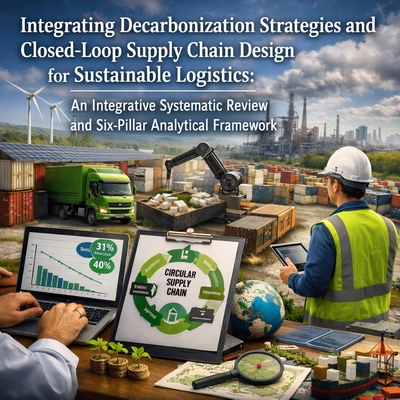
WITHDRAWN ------ Integrating decarbonization strategies and closed-loop supply chain design for sustainable logistics: An integrative systematic review and six-pillar analytical framework

Article Sidebar
Issue
Vol. 11 No. 1 (2026)
Keywords:
-
circular supply networks, low-carbon logistics systems, reverse flow optimization, green capital mechanisms, regional economic constraints, environmental monitoring systems
No galleys available
Abstract
Status: This article has been WITHDRAWN at the formal request of the authors.
Reason: The manuscript was withdrawn post-publication due to an administrative disagreement regarding the Article Processing Charge (APC). The Editorial Board notes that this withdrawal is purely administrative and is not related to any form of scientific or ethical misconduct, plagiarism, or unreliability of data. The full-text PDF has been removed from public access.
Purpose. This paper aims to address the fragmentation between decarbonization strategies and closed-loop supply chain (CLSC) design in sustainable logistics by developing an integrated analytical framework that captures their interdependencies across operational and contextual dimensions. Methodology. A hybrid systematic–integrative review was conducted, combining PRISMA-based literature selection with thematic synthesis. A total of 59 peer-reviewed studies (2012–2026) were analyzed and coded across six dimensions: technological enablers, CLSC design architecture, policy mechanisms, organizational preconditions, geoecological accountability, and regional macroeconomic context. Quantitative findings were standardized using relative change metrics and synthesized through a quality-weighted approach. Results. The analysis indicates that integrated decarbonization – CLSC approaches are associated with cost reductions of up to 31% and emission reductions of 12%-40% in modeled scenarios. The results further demonstrate that technological solutions alone are insufficient; their effectiveness depends on organizational capabilities, policy alignment, and regional economic conditions. Significant variability across contexts suggests that integration outcomes are highly contingent on local constraints. Theoretical contribution. The study advances the literature by proposing a six-pillar framework that reconceptualizes sustainable logistics as a multi-level governance problem rather than a purely operational optimization task. It contributes a structured approach for integrating fragmented research streams and incorporating macroeconomic and geoecological dimensions into supply chain analysis. Practical implications. The findings highlight the need for coordinated implementation strategies combining technological investment, organizational readiness, and context-sensitive policy design. The framework provides actionable guidance for practitioners, policymakers, and financial institutions seeking to operationalize sustainable logistics transitions.
Full text article
Generated from XML file
References
Abdulhasanova, R. (2025). Bridging the finance gap: Mobilizing capital for Azerbaijan's green economy transition. Scientific Work International Scientific Journal, 19(6), 29–33. https://doi.org/10.36719/2663-4619/118/29-33
Agrawal, S., Singh, R. K., & Murtaza, Q. (2015). A literature review and perspectives in reverse logistics. Resources, Conservation and Recycling, 97, 76–92. https://doi.org/10.1016/j.resconrec.2015.02.009
Ahmadova, S., Gasimov, J., & Huseynov, A. (2018). Macroeconomic targets of the country and its priorities prism socio-economic development of Nakhchivan Autonomous Republic. İqtisadi və Siyasi Elmlər Jurnalı, 1(10), 123–130.
Akbar, H., & Gheewala, S. H. (2026). Powering the future sustainably: Lithium-ion batteries across global supply chains. Renewable and Sustainable Energy Reviews. Advance online publication.
Alegoz, M., & Karaer, O. (2024). Compound effect of closing the loop and servitization in supply chains. International Journal of Production Economics, 267, Article 109082. https://doi.org/10.1016/j.ijpe.2024.109082
Aliyev, S., Hasanov, R. I., Aghayeva, K., Gasimov, J. Y., & Ahmadova, S. E. (2024). The relationship between renewable energy consumption and economic growth: Insights from Iceland and Azerbaijan. International Journal of Energy Economics and Policy, 14(5), 229–235. https://doi.org/10.32479/ijeep.16490
Amri, A., Lamsali, H., & Rajemi, M. F. (2025). Mapping the intersection of reverse logistics and sustainability. Paper Asia. Advance online publication.
Asgarova, M., & Abbasova, M. (2024). Are the Belt and Road project an alternative to historic Silk Way? Qədim Diyar International Online Scientific Journal, 6(7), 127. https://doi.org/10.36719/2706-6185/37/98-102
Ben Amor, E., Triki, H., & Benaissa, M. (2025). Sustainable warehouse management and AI: An alliance for a sustainable future. In Lecture Notes in Mechanical Engineering. Springer.
Bhatia, V., Arora, R., & Bhatia, B. (2026). Intelligent warehouses: Role of industrial robotics in supply chain management. In Industrial Robotics in Smart Manufacturing. IGI Global.
Borjian, A., Alinezhad, A., & Khalili, J. (2019). Closed-loop supply chain considering environmental investment and pollutants emissions. International Journal of Integrated Supply Management, 12(4), 323–349. https://doi.org/10.1504/IJISM.2019.103194
Caramia, M., & Pizzari, E. (2023). A bi-objective cap-and-trade model for minimizing environmental impact in closed-loop supply chains. Supply Chain Analytics, 4, Article 100042. https://doi.org/10.1016/j.sca.2023.100042
Cheng, W., Li, Q., Wu, Q., & Ye, F. (2024). Cooperative promotion and wholesale price discount incentives in a closed-loop supply chain with dynamic returns. SAGE Open, 14(1). https://doi.org/10.1177/21582440241234567
Chochliouros, I. P., Spiliopoulou, A. S., & Lazaridis, P. (2025). Automated logistics in the B5G/6G era. In IFIP Advances in Information and Communication Technology. Springer.
Ciliberto, C., & Mathiyazhagan, K. (2025). The green circuit: Integrating last mile and reverse logistics for circular supply chain excellence. In Sustainable Operations of Logistics and Supply Chain Management. Springer.
Farrokh, M., Zenouz, R. Y., Jamalnia, A., & Asadi, M. (2025). Sustainable tire closed-loop supply chain design under uncertain return and demand. International Journal of Supply and Operations Management. Advance online publication.
Fatorachian, H., & Kazemi, H. (2025). From linear to circular: Transitioning supply chains using advanced logistics and closed-loop supply chain theory. Cogent Business and Management. Advance online publication.
Genovese, A., Acquaye, A. A., Figueroa, A., & Koh, S. C. L. (2017). Sustainable supply chain management and the transition towards a circular economy. Resources, Conservation and Recycling, 120, 1–11. https://doi.org/10.1016/j.resconrec.2016.09.032
Govindan, K., & Soleimani, H. (2017). A review of reverse logistics and closed-loop supply chains. Journal of Cleaner Production, 142, 371–384. https://doi.org/10.1016/j.jclepro.2016.03.126
Hajiyev, M. A., Yurin, O. I., Galinska, T. A., Ovsii, D. M., Zeynalov, L. M., & Polukhov, I. K. (2025). Interior insulation strategies for cavity brick walls: Performance assessment and compliance. International Journal on Technical and Physical Problems of Engineering, 17(3), 363–371.
Jauhari, W. A., Kenlaksita, D. N., Kurdhi, N. A., & Utama, D. M. (2025). An optimization framework for sustainable closed-loop supply chains with green investment and recovery policy. Supply Chain Analytics, 100146. https://doi.org/10.1016/j.sca.2025.100146
Li, H., Wang, C., Xu, L., & Ou, W. (2017). Pricing, carbon emission reduction, collection decision, and coordination in a low-carbon closed-loop supply chain. Journal of Renewable and Sustainable Energy, 9(6), Article 065907. https://doi.org/10.1063/1.5010992
Li, Q., Zhang, H., & Liu, K. (2021). Closed-loop supply chain decision-making in different cooperation modes with government's reward-penalty mechanism. Sustainability, 13(12), Article 6425. https://doi.org/10.3390/su13126425
Li, X., Wang, Y., & Fu, Y. (2025). Research on pricing coordination strategy of closed-loop supply chain based on recycling quality grading under government participation. Alexandria Engineering Journal, 116, 90-103. https://doi.org/10.1016/j.aej.2024.12.067
Long, H., Liu, H., Li, X., & Chen, L. (2020). An evolutionary game theory study for construction and demolition waste recycling. International Journal of Environmental Research and Public Health, 17(16), Article 5664. https://doi.org/10.3390/ijerph17165664
Lozano-Oviedo, J., Cortes, C. E., & Rey, P. A. (2024). Sustainable closed-loop supply chains and their optimization models: A review. Clean Technologies and Environmental Policy, 26, 1297–1327. https://doi.org/10.1007/s10098-023-02681-4
Lu, J., Shan, R., Kittner, N., & Zhang, N. (2023). Emission reductions from heavy-duty freight electrification aided by smart fleet management. Transportation Research Part D: Transport and Environment, 119, Article 103759. https://doi.org/10.1016/j.trd.2023.103759
MahmoumGonbadi, A., Genovese, A., & Sgalambro, A. (2021). Closed-loop supply chain design for the transition towards a circular economy. Journal of Cleaner Production, 329, Article 129716. https://doi.org/10.1016/j.jclepro.2021.129716
McKinnon, A., & Piecyk, M. (2012). Setting targets for reducing carbon emissions from logistics. Carbon Management, 3(6), 615–628. https://doi.org/10.4155/cmt.12.62
Mohtashami, Z., Aghsami, A., & Jolai, F. (2020). A green closed loop supply chain design using queuing system. Journal of Cleaner Production, 242, Article 118452. https://doi.org/10.1016/j.jclepro.2019.118452
Mrad, M., Frikha, M. A., Boujelbene, Y., & Rahmouni, M. (2026). Technological pathways to low-carbon supply chains. Logistics. Advance online publication.
Nagasawa, K., Morikawa, K., Takahashi, K., & Hirotani, D. (2019). Sustainability and corporate social responsibility in closed loop supply chain. Procedia Manufacturing, 39, 1836–1843. https://doi.org/10.1016/j.promfg.2020.01.253
Neto, J. Q. F., Bloemhof-Ruwaard, J. M., van Nunen, J. A. E. E., & van Heck, E. (2008). Designing and evaluating sustainable logistics networks. International Journal of Production Economics, 111(2), 195–208. https://doi.org/10.1016/j.ijpe.2006.10.014
Nicoletti, B., & Appolloni, A. (2025). Warehouse 5.0 framework for a warehouse compatible with industry 5.0. International Journal of Logistics Research and Applications, 1-25. https://doi.org/10.1080/13675567.2025.2565224
Nicoletti, B., & Appolloni, A. (2025b). Artificial intelligence in support of warehousing 5.0 and the EU green taxonomy. In Springer Proceedings in Business and Economics. Springer.
Olapiriyakul, S., & Pannakkong, W. (2025). Sustainable food distribution approach: closed-loop network design strategies for fresh consumption and waste justice. Annals of Operations Research, 1-25. https://doi.org/10.1007/s10479-025-06919-8
Pajila, B. (2024). Smart warehousing technologies for energy efficiency. In Innovations in Green and Energy-Efficient Warehousing. IGI Global.
Pal, B., & Mukherjee, H. (2026). The effect of coupon policy and sales effort on sustainable multi-period dual-channel supply chain with recycles and refurbishes waste. Journal of the Operational Research Society, 77(5), 1355-1379. https://doi.org/10.1080/01605682.2025.2529531
Rathnasiri, M. S. H. (2025). Supply Chain Decarbonization and its Impact on the Environment and Society. In Zero Carbon Industry, Eco-Innovation and Environmental Sustainability (pp. 141-158). Cham: Springer Nature Switzerland.
Sabaghieh Yazd, M., Ramezanian, R., Varmazyar, M., Ebrahimi, S. B., & Esmaeeli, E. (2025). Designing a dual-channel production-distribution network for reducing greenhouse gas emissions based on customer segmentation. Journal of Industrial and Production Engineering, 42(7), 705-729. https://doi.org/10.1080/21681015.2025.2491459
Sardar, N., Javanshir, H., Molana, S. M. H., & Yazdian, S. A. (2026). An Integrated Robust Planning Model for Petrochemical Product in the Supply Chain. Process Integration and Optimization for Sustainability, 10(2), 753-769. https://doi.org/10.1007/s41660-025-00592-x
Seifbarghy, M., & Hamidi, M. (2023). Integration of supplier evaluation and closed-loop supply chain network design from internal and external stakeholders' perspectives using grey hybrid SWARA-COPRAS methods. International Journal of Mathematics in Operational Research, 25(1), 1-22. https://doi.org/10.1504/IJMOR.2023.131380
Shahidzadeh, M. H., Shokouhyar, S., Safari, A., Tirkolaee, E. B., & Shokoohyar, S. (2023). Discovering the secret behind managing WEEE: Deep learning method in the industry 4.0. Annals of Operations Research, 1-36. https://doi.org/10.1007/s10479-023-05632-8
Shekarian, E. (2020). A review of factors affecting closed-loop supply chain models. Journal of Cleaner Production, 253, 119823. https://doi.org/10.1016/j.jclepro.2019.119823
Song, H., Hou, G., & Jiang, L. (2026). Optimal decisions and coordination of power battery closed-loop supply chain considering fairness concerns and government subsidies. Transportation Research Part E: Logistics and Transportation Review, 206, 104521. https://doi.org/10.1016/j.tre.2025.104521
Sorooshian, S., Khiavi, S. F., Karimi, F., & Mina, H. (2024). Link between sustainable circular supply chain and Internet of Things technology in electric vehicle battery manufacturing industry: A business strategy optimization for pickup and delivery. Business strategy and the environment, 33(8), 8211-8232. https://doi.org/10.1002/bse.3905
Srinivas, A. C. M. V., Bethapudi, P., Kanna, R. R., Bharathi, M., & Zeynal, R. (2025). Fuzzy logic–genetic algorithm framework for energy-efficient task scheduling in IoT-enabled fog–cloud networks. In 2025 2nd Asian Conference on Intelligent Technologies (pp. 1–6). IEEE. https://doi.org/10.1109/ACOIT66109.2025.11436340
Syphoxay, P., & Hien, N. T. (2014). An exploratory study on closed-loop supply chain modelling under the emission trading scheme. In Proceedings of the Summer School Francesco Turco.
Tahmouresi, M. M., & Behnamian, J. (2025). Data-Driven Risk Mitigation and Flexibility Enhancement in Perishable Supply Chain Networks. Array, 100641. https://doi.org/10.1016/j.array.2025.100641
Tahoori, G., Rosnah, M. Y., & Norzima, Z. (2014). Key issues and challenges of a sustainable closed loop supply chain. Applied mechanics and materials, 564, 684-688. https://doi.org/10.4028/www.scientific.net/AMM.564.684
Taleizadeh, A. A., Tahmasbifar, Z., Moradi, R., Sarker, B. R., & Hafezalkotob, A. (2025). An optimum decision-making strategy to maximize total profit in a two-period closed-loop supply chain dealing with greenhouse gases. Annals of Operations Research, 1-35. https://doi.org/10.1007/s10479-025-06610-y
Wang, Y., & Wang, Z. (2025). Edge Computing Integration in 5G Core on Real‐Time Data Processing for Smart Applications. Internet Technology Letters, 8(5), e70074. https://doi.org/10.1002/itl2.70074
Wen, Z., Dou, X., Fu, X., & Feng, T. (2026). Relay transport network design for sustainable trucking industry considering carbon emissions and driver working conditions. Transport Policy, 104033. https://doi.org/10.1016/j.tranpol.2026.104033
Wube, W., Berhan, E., & Tesfaye, G. (2025). Decision support systems for a resilient and sustainable closed loop supply chain under risk: a systematic review and future research directions. Cleaner Logistics and Supply Chain, 15, 100217. https://doi.org/10.1016/j.clscn.2025.100217
Yang, Y., & Xu, X. (2019). A differential game model for closed-loop supply chain participants under carbon emission permits. Computers & Industrial Engineering, 135, 1077-1090. https://doi.org/10.1016/j.cie.2019.03.049
Yozgat, S., & Erol, S. (2022, July). Sustainable closed-loop supply chain network design and optimization. In International Conference on Management Science and Engineering Management (pp. 705-726). Cham: Springer International Publishing. https://doi.org/10.1007/978-3-031-10388-9_52
Yuniarti, R., & Arvitrida, N. I. (2025). A scoping review and bibliometric analysis of sustainable and resilient supply chain network design. Supply Chain Analytics, 100162. https://doi.org/10.1016/j.sca.2025.100162
Zheng, W., Ji, X., Zou, Y., & Wang, L. (2025). Optimization of Vehicle Routing in Green Cold Chain Logistics Distribution Considering Customer Satisfaction. Discrete Dynamics in Nature and Society, 2025(1), 2467398. https://doi.org/10.1155/ddns/2467398
Agrawal, S., Singh, R. K., & Murtaza, Q. (2015). A literature review and perspectives in reverse logistics. Resources, Conservation and Recycling, 97, 76–92. https://doi.org/10.1016/j.resconrec.2015.02.009
Ahmadova, S., Gasimov, J., & Huseynov, A. (2018). Macroeconomic targets of the country and its priorities prism socio-economic development of Nakhchivan Autonomous Republic. İqtisadi və Siyasi Elmlər Jurnalı, 1(10), 123–130.
Akbar, H., & Gheewala, S. H. (2026). Powering the future sustainably: Lithium-ion batteries across global supply chains. Renewable and Sustainable Energy Reviews. Advance online publication.
Alegoz, M., & Karaer, O. (2024). Compound effect of closing the loop and servitization in supply chains. International Journal of Production Economics, 267, Article 109082. https://doi.org/10.1016/j.ijpe.2024.109082
Aliyev, S., Hasanov, R. I., Aghayeva, K., Gasimov, J. Y., & Ahmadova, S. E. (2024). The relationship between renewable energy consumption and economic growth: Insights from Iceland and Azerbaijan. International Journal of Energy Economics and Policy, 14(5), 229–235. https://doi.org/10.32479/ijeep.16490
Amri, A., Lamsali, H., & Rajemi, M. F. (2025). Mapping the intersection of reverse logistics and sustainability. Paper Asia. Advance online publication.
Asgarova, M., & Abbasova, M. (2024). Are the Belt and Road project an alternative to historic Silk Way? Qədim Diyar International Online Scientific Journal, 6(7), 127. https://doi.org/10.36719/2706-6185/37/98-102
Ben Amor, E., Triki, H., & Benaissa, M. (2025). Sustainable warehouse management and AI: An alliance for a sustainable future. In Lecture Notes in Mechanical Engineering. Springer.
Bhatia, V., Arora, R., & Bhatia, B. (2026). Intelligent warehouses: Role of industrial robotics in supply chain management. In Industrial Robotics in Smart Manufacturing. IGI Global.
Borjian, A., Alinezhad, A., & Khalili, J. (2019). Closed-loop supply chain considering environmental investment and pollutants emissions. International Journal of Integrated Supply Management, 12(4), 323–349. https://doi.org/10.1504/IJISM.2019.103194
Caramia, M., & Pizzari, E. (2023). A bi-objective cap-and-trade model for minimizing environmental impact in closed-loop supply chains. Supply Chain Analytics, 4, Article 100042. https://doi.org/10.1016/j.sca.2023.100042
Cheng, W., Li, Q., Wu, Q., & Ye, F. (2024). Cooperative promotion and wholesale price discount incentives in a closed-loop supply chain with dynamic returns. SAGE Open, 14(1). https://doi.org/10.1177/21582440241234567
Chochliouros, I. P., Spiliopoulou, A. S., & Lazaridis, P. (2025). Automated logistics in the B5G/6G era. In IFIP Advances in Information and Communication Technology. Springer.
Ciliberto, C., & Mathiyazhagan, K. (2025). The green circuit: Integrating last mile and reverse logistics for circular supply chain excellence. In Sustainable Operations of Logistics and Supply Chain Management. Springer.
Farrokh, M., Zenouz, R. Y., Jamalnia, A., & Asadi, M. (2025). Sustainable tire closed-loop supply chain design under uncertain return and demand. International Journal of Supply and Operations Management. Advance online publication.
Fatorachian, H., & Kazemi, H. (2025). From linear to circular: Transitioning supply chains using advanced logistics and closed-loop supply chain theory. Cogent Business and Management. Advance online publication.
Genovese, A., Acquaye, A. A., Figueroa, A., & Koh, S. C. L. (2017). Sustainable supply chain management and the transition towards a circular economy. Resources, Conservation and Recycling, 120, 1–11. https://doi.org/10.1016/j.resconrec.2016.09.032
Govindan, K., & Soleimani, H. (2017). A review of reverse logistics and closed-loop supply chains. Journal of Cleaner Production, 142, 371–384. https://doi.org/10.1016/j.jclepro.2016.03.126
Hajiyev, M. A., Yurin, O. I., Galinska, T. A., Ovsii, D. M., Zeynalov, L. M., & Polukhov, I. K. (2025). Interior insulation strategies for cavity brick walls: Performance assessment and compliance. International Journal on Technical and Physical Problems of Engineering, 17(3), 363–371.
Jauhari, W. A., Kenlaksita, D. N., Kurdhi, N. A., & Utama, D. M. (2025). An optimization framework for sustainable closed-loop supply chains with green investment and recovery policy. Supply Chain Analytics, 100146. https://doi.org/10.1016/j.sca.2025.100146
Li, H., Wang, C., Xu, L., & Ou, W. (2017). Pricing, carbon emission reduction, collection decision, and coordination in a low-carbon closed-loop supply chain. Journal of Renewable and Sustainable Energy, 9(6), Article 065907. https://doi.org/10.1063/1.5010992
Li, Q., Zhang, H., & Liu, K. (2021). Closed-loop supply chain decision-making in different cooperation modes with government's reward-penalty mechanism. Sustainability, 13(12), Article 6425. https://doi.org/10.3390/su13126425
Li, X., Wang, Y., & Fu, Y. (2025). Research on pricing coordination strategy of closed-loop supply chain based on recycling quality grading under government participation. Alexandria Engineering Journal, 116, 90-103. https://doi.org/10.1016/j.aej.2024.12.067
Long, H., Liu, H., Li, X., & Chen, L. (2020). An evolutionary game theory study for construction and demolition waste recycling. International Journal of Environmental Research and Public Health, 17(16), Article 5664. https://doi.org/10.3390/ijerph17165664
Lozano-Oviedo, J., Cortes, C. E., & Rey, P. A. (2024). Sustainable closed-loop supply chains and their optimization models: A review. Clean Technologies and Environmental Policy, 26, 1297–1327. https://doi.org/10.1007/s10098-023-02681-4
Lu, J., Shan, R., Kittner, N., & Zhang, N. (2023). Emission reductions from heavy-duty freight electrification aided by smart fleet management. Transportation Research Part D: Transport and Environment, 119, Article 103759. https://doi.org/10.1016/j.trd.2023.103759
MahmoumGonbadi, A., Genovese, A., & Sgalambro, A. (2021). Closed-loop supply chain design for the transition towards a circular economy. Journal of Cleaner Production, 329, Article 129716. https://doi.org/10.1016/j.jclepro.2021.129716
McKinnon, A., & Piecyk, M. (2012). Setting targets for reducing carbon emissions from logistics. Carbon Management, 3(6), 615–628. https://doi.org/10.4155/cmt.12.62
Mohtashami, Z., Aghsami, A., & Jolai, F. (2020). A green closed loop supply chain design using queuing system. Journal of Cleaner Production, 242, Article 118452. https://doi.org/10.1016/j.jclepro.2019.118452
Mrad, M., Frikha, M. A., Boujelbene, Y., & Rahmouni, M. (2026). Technological pathways to low-carbon supply chains. Logistics. Advance online publication.
Nagasawa, K., Morikawa, K., Takahashi, K., & Hirotani, D. (2019). Sustainability and corporate social responsibility in closed loop supply chain. Procedia Manufacturing, 39, 1836–1843. https://doi.org/10.1016/j.promfg.2020.01.253
Neto, J. Q. F., Bloemhof-Ruwaard, J. M., van Nunen, J. A. E. E., & van Heck, E. (2008). Designing and evaluating sustainable logistics networks. International Journal of Production Economics, 111(2), 195–208. https://doi.org/10.1016/j.ijpe.2006.10.014
Nicoletti, B., & Appolloni, A. (2025). Warehouse 5.0 framework for a warehouse compatible with industry 5.0. International Journal of Logistics Research and Applications, 1-25. https://doi.org/10.1080/13675567.2025.2565224
Nicoletti, B., & Appolloni, A. (2025b). Artificial intelligence in support of warehousing 5.0 and the EU green taxonomy. In Springer Proceedings in Business and Economics. Springer.
Olapiriyakul, S., & Pannakkong, W. (2025). Sustainable food distribution approach: closed-loop network design strategies for fresh consumption and waste justice. Annals of Operations Research, 1-25. https://doi.org/10.1007/s10479-025-06919-8
Pajila, B. (2024). Smart warehousing technologies for energy efficiency. In Innovations in Green and Energy-Efficient Warehousing. IGI Global.
Pal, B., & Mukherjee, H. (2026). The effect of coupon policy and sales effort on sustainable multi-period dual-channel supply chain with recycles and refurbishes waste. Journal of the Operational Research Society, 77(5), 1355-1379. https://doi.org/10.1080/01605682.2025.2529531
Rathnasiri, M. S. H. (2025). Supply Chain Decarbonization and its Impact on the Environment and Society. In Zero Carbon Industry, Eco-Innovation and Environmental Sustainability (pp. 141-158). Cham: Springer Nature Switzerland.
Sabaghieh Yazd, M., Ramezanian, R., Varmazyar, M., Ebrahimi, S. B., & Esmaeeli, E. (2025). Designing a dual-channel production-distribution network for reducing greenhouse gas emissions based on customer segmentation. Journal of Industrial and Production Engineering, 42(7), 705-729. https://doi.org/10.1080/21681015.2025.2491459
Sardar, N., Javanshir, H., Molana, S. M. H., & Yazdian, S. A. (2026). An Integrated Robust Planning Model for Petrochemical Product in the Supply Chain. Process Integration and Optimization for Sustainability, 10(2), 753-769. https://doi.org/10.1007/s41660-025-00592-x
Seifbarghy, M., & Hamidi, M. (2023). Integration of supplier evaluation and closed-loop supply chain network design from internal and external stakeholders' perspectives using grey hybrid SWARA-COPRAS methods. International Journal of Mathematics in Operational Research, 25(1), 1-22. https://doi.org/10.1504/IJMOR.2023.131380
Shahidzadeh, M. H., Shokouhyar, S., Safari, A., Tirkolaee, E. B., & Shokoohyar, S. (2023). Discovering the secret behind managing WEEE: Deep learning method in the industry 4.0. Annals of Operations Research, 1-36. https://doi.org/10.1007/s10479-023-05632-8
Shekarian, E. (2020). A review of factors affecting closed-loop supply chain models. Journal of Cleaner Production, 253, 119823. https://doi.org/10.1016/j.jclepro.2019.119823
Song, H., Hou, G., & Jiang, L. (2026). Optimal decisions and coordination of power battery closed-loop supply chain considering fairness concerns and government subsidies. Transportation Research Part E: Logistics and Transportation Review, 206, 104521. https://doi.org/10.1016/j.tre.2025.104521
Sorooshian, S., Khiavi, S. F., Karimi, F., & Mina, H. (2024). Link between sustainable circular supply chain and Internet of Things technology in electric vehicle battery manufacturing industry: A business strategy optimization for pickup and delivery. Business strategy and the environment, 33(8), 8211-8232. https://doi.org/10.1002/bse.3905
Srinivas, A. C. M. V., Bethapudi, P., Kanna, R. R., Bharathi, M., & Zeynal, R. (2025). Fuzzy logic–genetic algorithm framework for energy-efficient task scheduling in IoT-enabled fog–cloud networks. In 2025 2nd Asian Conference on Intelligent Technologies (pp. 1–6). IEEE. https://doi.org/10.1109/ACOIT66109.2025.11436340
Syphoxay, P., & Hien, N. T. (2014). An exploratory study on closed-loop supply chain modelling under the emission trading scheme. In Proceedings of the Summer School Francesco Turco.
Tahmouresi, M. M., & Behnamian, J. (2025). Data-Driven Risk Mitigation and Flexibility Enhancement in Perishable Supply Chain Networks. Array, 100641. https://doi.org/10.1016/j.array.2025.100641
Tahoori, G., Rosnah, M. Y., & Norzima, Z. (2014). Key issues and challenges of a sustainable closed loop supply chain. Applied mechanics and materials, 564, 684-688. https://doi.org/10.4028/www.scientific.net/AMM.564.684
Taleizadeh, A. A., Tahmasbifar, Z., Moradi, R., Sarker, B. R., & Hafezalkotob, A. (2025). An optimum decision-making strategy to maximize total profit in a two-period closed-loop supply chain dealing with greenhouse gases. Annals of Operations Research, 1-35. https://doi.org/10.1007/s10479-025-06610-y
Wang, Y., & Wang, Z. (2025). Edge Computing Integration in 5G Core on Real‐Time Data Processing for Smart Applications. Internet Technology Letters, 8(5), e70074. https://doi.org/10.1002/itl2.70074
Wen, Z., Dou, X., Fu, X., & Feng, T. (2026). Relay transport network design for sustainable trucking industry considering carbon emissions and driver working conditions. Transport Policy, 104033. https://doi.org/10.1016/j.tranpol.2026.104033
Wube, W., Berhan, E., & Tesfaye, G. (2025). Decision support systems for a resilient and sustainable closed loop supply chain under risk: a systematic review and future research directions. Cleaner Logistics and Supply Chain, 15, 100217. https://doi.org/10.1016/j.clscn.2025.100217
Yang, Y., & Xu, X. (2019). A differential game model for closed-loop supply chain participants under carbon emission permits. Computers & Industrial Engineering, 135, 1077-1090. https://doi.org/10.1016/j.cie.2019.03.049
Yozgat, S., & Erol, S. (2022, July). Sustainable closed-loop supply chain network design and optimization. In International Conference on Management Science and Engineering Management (pp. 705-726). Cham: Springer International Publishing. https://doi.org/10.1007/978-3-031-10388-9_52
Yuniarti, R., & Arvitrida, N. I. (2025). A scoping review and bibliometric analysis of sustainable and resilient supply chain network design. Supply Chain Analytics, 100162. https://doi.org/10.1016/j.sca.2025.100162
Zheng, W., Ji, X., Zou, Y., & Wang, L. (2025). Optimization of Vehicle Routing in Green Cold Chain Logistics Distribution Considering Customer Satisfaction. Discrete Dynamics in Nature and Society, 2025(1), 2467398. https://doi.org/10.1155/ddns/2467398
Authors
Abdulhasanova, R., Ahmadova, S., & Alasgarova, F. (2026). WITHDRAWN ------ Integrating decarbonization strategies and closed-loop supply chain design for sustainable logistics: An integrative systematic review and six-pillar analytical framework. Journal of Sustainable Development of Transport and Logistics, 11(1), 97–117. https://doi.org/10.14254/jsdtl.2026.11-1.5
Copyright (c) 2026 Rahiba Abdulhasanova, Sadagat Ahmadova, Flora Alasgarova

This work is licensed under a Creative Commons Attribution 4.0 International License.
Authors retain copyright and grant the journal right of first publication, with the work simultaneously licensed under a CC BY 4.0 License that allows others to share the work with an acknowledgement of the work's authorship and initial publication in this journal.