
Beyond TEU: Redefining container efficiency through value density metrics

Article Sidebar
-
container efficiency, value density, TEU, port benchmarking, HS codes, UN Comtrade, supply chain metrics
Abstract
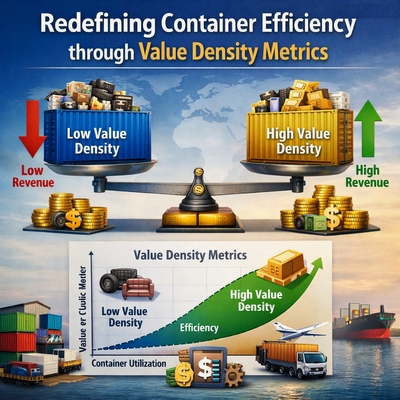
Purpose. This paper develops a Value Density Efficiency Index (VDEI) to supplement TEU-based container and port performance measures with economic-intensity indicators that are more relevant to supply chain decision-making. Methodology. The study uses a conceptual modeling and pilot empirical illustration design. Publicly available HS-coded trade data are linked to container payload and cubic-capacity constraints to calculate value per kilogram, value per cubic meter of cargo or reserved capacity, and implied value per container. Results. An illustrative comparison of Canadian imports of coffee (HS 090111) and medicaments (HS 300490) shows that shipments with similar physical container requirements can carry sharply different economic value. In the pilot calculation, medicaments show approximately twenty times higher value per kilogram than coffee, demonstrating the limits of TEU-only efficiency indicators. Theoretical contribution. The paper contributes a reproducible metric family that connects transport economics, HS-coded trade statistics, and container-capacity constraints. It supports more disaggregated benchmarking of port and supply chain performance than a single TEU-output measure. Practical implications. VDEI can support carrier capacity allocation, port benchmarking, insurance and risk assessment, and disruption-prioritization decisions by showing the economic yield of constrained container space.
Sustainable Development Goals (SDGs): SDG 9: Industry, Innovation and Infrastructure
Full text article
References
Berthou, A., & Emlinger, C. (2011). The Trade Unit Values database. Économie internationale, 128(4), 97-117. https://doi.org/10.3917/ecoi.128.0097.
Cochrane, R. A. (2008). The effects of market differences on the throughput of large container terminals with similar levels of efficiency. Maritime Economics & Logistics, 10(1–2), 35–52. https://doi.org/10.1057/palgrave.mel.9100190
Ducruet, C., Itoh, H., & Merk, O. (2014). Time efficiency at world container ports (International Transport Forum Discussion Paper No. 2014-08). OECD/International Transport Forum. https://doi.org/10.1787/5jrw2z46t56l-en
Heilig, L., Lalla-Ruiz, E., & Voß, S. (2022). Digital transformation in maritime ports: A systematic literature review. Maritime Economics & Logistics, 24(2), 190-213.
Hummels, D. (2007). Transportation costs and international trade in the second era of globalization. Journal of Economic Perspectives, 21(3), 131–154. https://doi.org/10.1257/jep.21.3.131
Hummels, D., & Schaur, G. (2013). Time as a trade barrier. American Economic Review, 103(7), 2935–2959. https://doi.org/10.1257/aer.103.7.2935
Ivanov, D., & Dolgui, A. (2021). A digital supply chain twin for managing the disruption risks and resilience in the era of Industry 4.0. Production Planning & Control, 32(7), 775–788. https://doi.org/10.1080/09537287.2020.1768450
Mediterranean Shipping Company. (2024). Dry shipping containers: Types, sizes, and commodities. MSC. https://www.msc.com/en/lp/blog/solutions/guide-to-dry-cargo-container-types Accessed: August 15, 2026.
Serra, P., & Bottero, M. (2023). A review of port KPIs considering safety, environment and social aspects. In Computational Science and Its Applications – ICCSA 2023 (Lecture Notes in Computer Science, Vol. 14110, pp. 577–593). Springer. https://doi.org/10.1007/978-3-031-37123-3_40
Song, D. P., & Dong, J. X. (2014). Empty container repositioning. In Handbook of ocean container transport logistics: making global supply chains effective (pp. 163-208). Cham: Springer International Publishing. https://doi.org/10.1007/978-3-319-11891-8_6
Tang, X., Xu, C., Wang, C., & Song, J. (2023). A study on the influence of reposition threshold on low-carbon empty container repositioning strategy under an uncertain environment. Frontiers in Marine Science, 10, 1174395. https://doi.org/10.3389/fmars.2023.1174395
Transport Information Service. (n.d.). Stowage factor. German Insurance Association. https://www.tis-gdv.de/tis_e/misc/staumass-htm/ Accessed: August 15, 2026.
United Nations. (2015). Sustainable Development Goal 9: Industry, Innovation and Infrastructure. https://sdgs.un.org/goals/goal9 Accessed: August 15, 2026.
United Nations Statistics Division. (2019). Trade data processing and validation methodology: Part UN Comtrade. United Nations. https://comtradeapi.un.org/files/v1/app/publicationfiles/2019/VolI2019.pdf Accessed: August 15, 2026.
UNCTAD. (2018). Review of maritime transport 2018. United Nations Conference on Trade and Development. https://unctad.org/publication/review-maritime-transport-2018
Wang, K., Hu, Q., Zhou, M., Zun, Z., & Qian, X. (2021). Multi-aspect applications and development challenges of digital twin-driven management in global smart ports. Case Studies on Transport Policy, 9(3), 1298-1312. https://doi.org/10.1016/j.cstp.2021.06.014
World Bank & S&P Global. (2022). The Container Port Performance Index 2021: A comparable assessment of container port performance. World Bank. https://doi.org/10.1596/37542
World Customs Organization. (n.d.). What is the Harmonized System (HS)? https://www.wcoomd.org/en/topics/nomenclature/overview/what-is-the-harmonized-system Accessed: August 15, 2026.
World Integrated Trade Solution. (2023a). Canada imports of coffee, not roasted or decaffeinated (HS 090111): Trade value and quantity. World Bank. https://wits.worldbank.org Accessed: August 15, 2026.
World Integrated Trade Solution. (2023b). Canada imports of medicaments, other (HS 300490): Trade value and quantity. World Bank. https://wits.worldbank.org Accessed: August 15, 2026.
Xu, X., Yang, H. C., Jeong, K., Bui, W., Ravulaparthy, S., Laarabi, H., ... & Spurlock, C. A. (2024). Teaching freight mode choice models new tricks using interpretable machine learning methods. Frontiers in Future Transportation, 5, 1339273.. https://doi.org/10.3389/ffutr.2024.1339273
Zhang, J., Yang, D., & Luo, M. (2024). Port efficiency types and perspectives: A literature review. Transport Policy, 156, 13-24. https://doi.org/10.1016/j.tranpol.2024.07.014
Authors
Copyright (c) 2026 Yoav Yosipovich

This work is licensed under a Creative Commons Attribution 4.0 International License.
Authors retain copyright and grant the journal right of first publication, with the work simultaneously licensed under a CC BY 4.0 License that allows others to share the work with an acknowledgement of the work's authorship and initial publication in this journal.